“War! We’re Going To War!”

Thursday of Week 30 in Ordinary Time (Year II)
Ephesians 6:10-20 | Psalm 143:1-2,9-10 | Luke 13:31-35


The militaristic tone that St. Paul adopts in today’s reading reminds me of our visit to St. Patrick’s Cathedral in Dublin, Ireland, at the start of our UK Catholic tour. There, I was introduced to the tradition of memorialising war heroes, with numerous monuments to officers who fell in battle, and combat unit flags flown high, deliberately left to degrade and unravel over time in homage to the regiments of old soldiers who “never die, they just fade away”.

But as modern man tired of worldwide conflict, a different monument sprang up within the cathedral to offset the glorification of war: the Tree of Remembrance.

Monuments to heroes, flags of regimental honour…and a stripped steel tree to remind us of the cost of secular war.

As the official cathedral website describes the juxtaposition:

Many of the monuments in the building represent those whose families have paid to have their relative remembered. These monuments represent a time when war was often glamorised and death through conflict described as “glorious.”

Today, St. Patrick’s Cathedral takes a very different view of remembrance. Death in wartime is solemnly remembered as a tragic loss of life. Remembrance must be inclusive rather than exclusive. All those who have been affected by violence or conflict are today remembered in the Cathedral.

The Tree of Remembrance was erected in the North Transept of the Cathedral. The monument uses a simple, neutral symbol of nature – the tree. However, the tree has been broken and destroyed by war and is made, not from natural materials, but from steel. This is intended to reflect modern industrial warfare. The base of the tree is surrounded by barbed wire, a universal symbol of conflict.

Visitors to the space are invited to remember a loved one who has been affected by conflict by filling out a small leave shaped tag and tying it to the barbed wire. Over time, the barbed wire will be covered with messages of hope.

(If you’re wondering where all the messages went, they make up the green and white “mat” at the foot of the tree.)

✞ ✞ ✞ ✞ ✞

Of course, St. Paul actually referred to spiritual warfare, and St. Patrick’s Cathedral commemorates that too, with a truncated version of that famous incantation that is St. Patrick’s Breastplate:
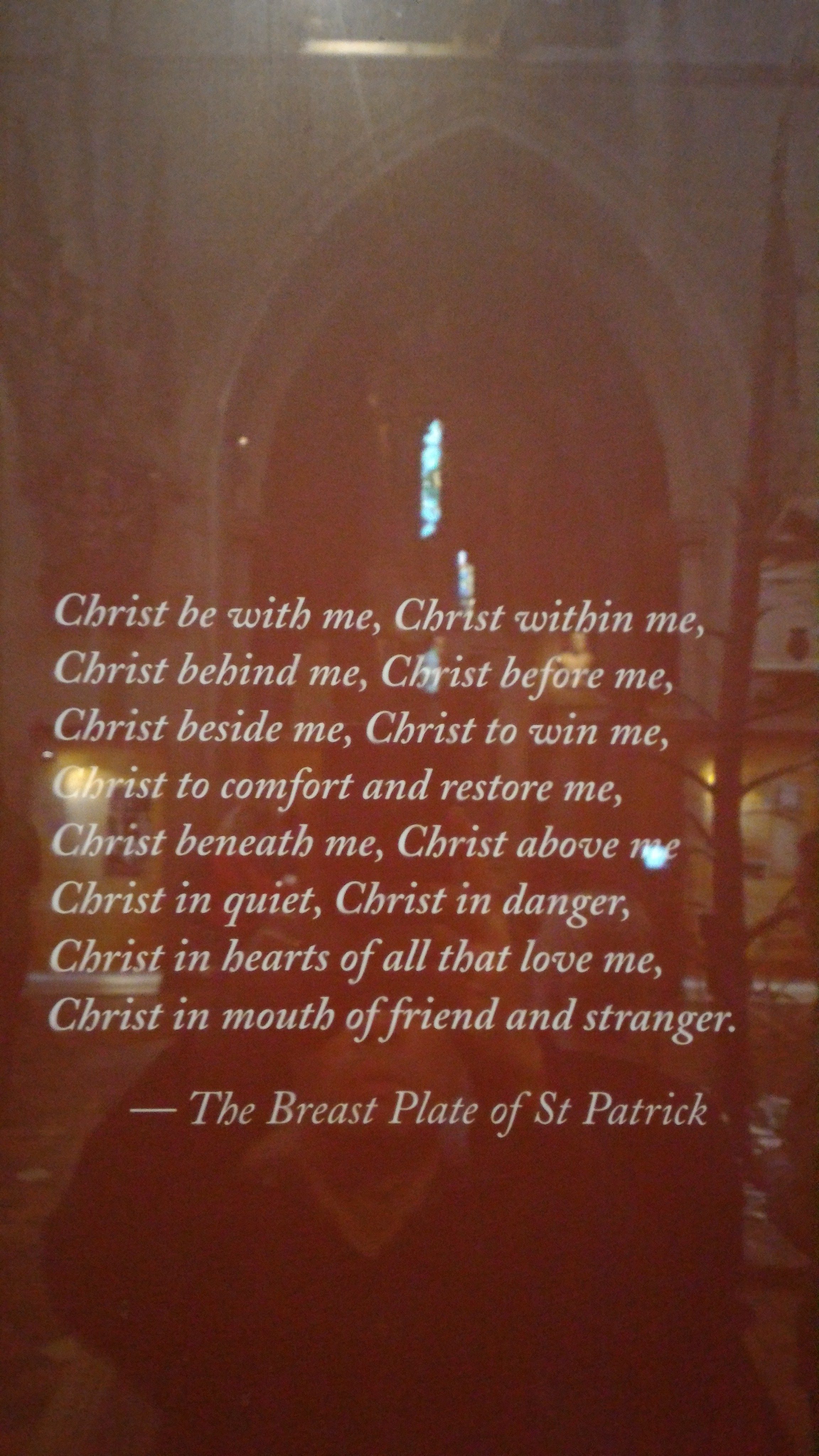
Christ be with me, Christ within me,
Christ behind me, Christ before me,
Christ beside me, Christ to win me,
Christ to comfort and restore me,
Christ beneath me, Christ above me,
Christ in quiet, Christ in danger,
Christ in hearts of all that love me,
Christ in mouth of friend and stranger.

✞ ✞ ✞ ✞ ✞

Now, it’s easy to see and love the Christ we face in the people we love.

It’s a lot harder to see and love the Christ we face in the people we don’t like, the ones who make our lives miserable.

And it’s almost impossible to remember that our quarrel is not with them, but with the Evil One that prods them with empty promises.

St. Paul understood that all too well, and reminds us that:

it is not against human enemies that we have to struggle, but against the Sovereignties and the Powers who originate the darkness in this world, the spiritual army of evil in the heavens. (Ephesians 6:12)

So let us gird for war with Satan and his minions, fortified with daily prayer and fervent love as children of the Almighty.

And since we need competent leadership in our daily struggle, let us invoke the help of God’s commanding general:

Saint Michael Archangel,
defend us in battle,
be our protection against the wickedness and snares of the devil;
may God rebuke him, we humbly pray;
and do thou, O Prince of the heavenly host,
by the power of God, cast into hell
Satan and all the evil spirits
who prowl through the world seeking the ruin of souls.
Amen.

Elitism in Salvation

Wednesday of Week 30 in Ordinary Time (Year II)
Ephesians 6:1-9 | Psalm 144:10-14 | Luke 13:22-30


Someone said to Jesus, ‘Sir, will there be only a few saved?’ (Luke 13:23)

Since scripture doesn’t describe the person who asked this question, we don’t know if it was someone who was genuinely concerned about his fellow men, or one who subscribed to the salvation viewpoint of “the few, the righteous, the chosen…the elite.”

With the benefit of two millennia of hindsight, we can of course confidently state that Jesus came to save all who would accept Him and live by His precepts of love for God and neighbor alike. Our ancestry, religious or otherwise, has no bearing. Our wealth, our list of patrons, our standing in society – all of that counts for nothing when it comes to our salvation.

Christ came to save everyone, the great and the lowly, but that message didn’t sink in back then.

And even today, how many of us still unconsciously look upon our non-Catholic brethren and quietly tell ourselves, “oh man, you’re going to hell.” Or worse, actually curse someone in anger to “go to hell!” and actually mean it in our hearts?

How many of us thump the family Bible and commit our children to weekly catechism, but pay scant attention during Sunday mass and leave after communion, determined to minimize our personal commitment?

How many of us only pay lip service to Jesus’ commandment, pontificating about God’s love with chapter, verse and canon law citations, but showing scant courtesy to the workers around us, to the point where onlookers react with “wow, what arrogant hypocrites Catholics are”?

✞ ✞ ✞ ✞ ✞

Throughout my career, I’ve unavoidably dealt with computer security on an almost daily basis. In this field, we have a simple maxim:

There are two kinds of people/companies/networks:
Those that have been hacked
And those that will be

Similarly:

There are two kinds of people:
Those who have accepted salvation
And those who haven’t…yet

But what does it mean to “accept salvation?” I think it’s simply living the Gospel life:

  • Love God with our all. Pray unceasingly, worship unreservedly, make time to ponder scripture, turn away from sin.
  • Love our neighbor as ourselves. Help others in whatever way we can, give generously, join with others’ sufferings in prayer, show by example the way to God.

To do otherwise is to arrogantly tell God “I want no part of salvation”, and to reap the consequences in the hereafter. Thankfully, it’s not too late:

to humble ourselves to accept this precious gift,

to commit ourselves to wholehearted love in thought, word and deed,

so as to join “Abraham and Isaac and Jacob and all the prophets in the kingdom of God, [and] men from east and west, from north and south, […] to take their places at the feast in the kingdom of God.” (Luke 13:28-29)

Amen.

The Word of God: The Ultimate Rickroll

Tuesday of Week 30 in Ordinary Time (Year II)
Ephesians 5:21-33 | Psalm 127:1-5 | Luke 13:18-21


The kingdom of God is like a mustard seed which a man took and threw into his garden: it grew and became a tree, and the birds of the air sheltered in its branches. (Luke 13:19)

It’s remarkable how a translation’s choice of words can send one’s mind in a specific direction. Today, for me, that word is “threw”. It sounds so casual, so indifferent.

Is that how we are called to treat the “seed” to the kingdom of God that is His Holy Word, to cast it aside in neglect?

I think not. I think it’s an indication of just how resilient the Word of God is, how it continues to inspire piety and faithfulness despite the frailties and peccadilloes of we who were called to the faith, despite the reluctance and guilt of we who are called to sow (not throw) the seed.

See, secular interests are like last year’s pop songs. They may have made a great impact on us, particularly romantic ballads at wedding feasts, but give it a few years, and we’ll forget the words, forget the tune, perhaps even forget that the songs existed.

But the Word of God, translated into thousand-year-old words, still invades our minds every day, even outside the confines of Holy Mass.

Think someone’s spending too much time on themselves? “Vanity of vanities, all is vanity.” (Ecclesiastus 1:2)

Annoyed that someone’s being unfairly critical? “Judge not, lest ye be judged.” (Matthew 7:1)

Trying to get someone to work with you? “Two are better than one.” (Ecclesiastus 4:9)

Trying to excuse your lack of commitment to daily exercise and/or prayer? “The spirit is willing, but the flesh is weak.” (Matthew 26:41)

Having a really bad day? Pretty much everyone knows Psalm 23, and more still could quote John 3:16.

Getting annoyed by that guy who keeps dropping Bible references to what you thought were secular sentiments? Relax, you’re just getting spiritually rickrolled. As the British Government of 1939 reminded its citizens, Keep Calm and

Never gonna give you up
Never gonna let you down
Never gonna run around and desert you
Never gonna make you cry
Never gonna say goodbye
Never gonna tell a lie and hurt you

Now, let us cry for help to the Lord, as we do whenever we need somebody, for we strong, strong men aren’t too proud to beg Him to take us to His heart and hold us in His loving arms. He has promised that he would never give up on the ones He loves, so we should not give up on His love, and continue to sing His praises, confident that all the angels and saints are on our side, and that we will be reunited with Him in heaven forever.

Lord, You know that when things don’t go our way,
we’ll give you up,
we’ll let you down,
we’ll desert You,
we’ll lie, cheat and steal,
we’ll hurt You.

Lord, we beseech You, do not hold all that against us, for our spirit is willing but our flesh is weak. Give us the strength to rise above our weaknesses, to do what is right in Your sight, to offer each day to You a simple sacrifice of our thoughts, our words, our deeds.

For yours is the kingdom, the power and the glory, now and for ever. Amen.

God Doesn’t Clock In

Monday of Week 30 in Ordinary Time (Year II)
Saint Antony Mary Claret, Bishop
Ephesians 4:32-5:8 | Psalm 1:1-4,6 | Luke 13:10-17


But the Lord answered him. ‘Hypocrites!’ he said ‘Is there one of you who does not untie his ox or his donkey from the manger on the sabbath and take it out for watering? (Luke 13:15)

As humans, we have a strange relationship with time: we want everything now, but lament that there’s not enough time for the things we want.

In today’s Gospel, Jesus berates the synagogue official for placing a time restriction on “healing works”. In modern times, we have the opposite problem: Sunday, or more precisely an hour or so thereof, is for the Lord to be with us, and everything else is for “me, myself and I”.

It is we who want to place limits on our time with God, but we also want God to jump in to help us at any time, anywhere. Right here and right now, Lord.

There’s only one class of people on whom we make such demands: servants.

Perhaps some soul-searching is called for. Are we doing to God the equivalent of “paying minimum wage, yet expecting everything done exactly the way we want it”? Perhaps we forget that:

God doesn’t clock in; He’s always there.
We do the clocking in, reluctantly.

God doesn’t clock out; He’s always there.
We do the clocking out, with unseeming haste.

God is the best friend we could ever meet in our lives.
We treat Him like a personal butler.

God just asks for our fidelity.
We treat Him like an employee with unreasonable demands.

Clearly, we can do better in our relationship with God. We just need to take the first steps today: download and use a mobile app like Daily Reflections (Android) or DGems (iOS) during our coffee breaks, or pray an entire rosary if we’re stuck on the train for a half-hour. Then we can so the same thing tomorrow, and the day after, and so on.

Let’s not wait till the weekend, when we drag ourselves laboriously to church, wondering why we even bother.

Lord, save us from our own apathy. Inspire us to read your Holy Word, and spend time pondering it, and be enlivened by it, and be empowered to live it in love for You and for our fellow humans. Amen.

The Perils of Blind Faith

30th Sunday in Ordinary Time (Year C)
Ecclesiasticus 35:12-14, 16-19 | Psalm 33:2-3,17-19,23 | 2 Timothy 4:6-8,16-18 | Luke 18:9-14


The Lord is a judge who is no respecter of personages. (Ecclesiasticus 35:12)

“The rich and powerful get away with murder.”

That’s a oft-repeated grouse that, unfortunately, does bear a kernel of truth. Ask anyone to cite an example, and it’s a rare person who can’t come up with one. Granted, some of their accusations may turn out to be pure hearsay, but I think there have been enough real-life instances through the years, of lawbreakers who were let off lightly (or completely), because making them pay the full measure for their crimes would’ve caused too much societal or economic disruption to be worthwhile. Or, perhaps, said offenders paid handsomely for their offences to be quietly buried…

✞ ✞ ✞ ✞ ✞

We tend to blindly trust those whom we feel to be “trustworthy” for one vague reason or another. At a basic level, we often cast critical thinking aside when it comes to incredible assertions received from our friends and family over social media, written in an authoritative style and citing reputable sources like “BBC World News” and “a Mayo Clinic health study”, or appealing to our desires and beliefs like “FREE Microsoft Surface when you forward to 50 friends!”

On a more dangerous level, we tend not to question assertions and doctrine promulgated by those whom we deem to be in authority, especially when (again) they align with our desires and beliefs. So many people believe the message of the prosperity gospel because “pastor said so,” and who doesn’t want to be wealthy? The investment recommendations of Warren Buffett are more sought after than gold, at least for those who worship at the Temple of the “Oracle of Omaha”.

And, sometimes, we confuse “cults of personality” for actual authority. If Mel Gibson, acclaimed director of The Passion of the Christ, tweeted, “Heard rumors Pope F. considering female ordination question,” I’m sure a thousand times ten thousand Catholics would retweet “POPE OKAYS FEMALE PRIESTS! ABOUT TIME!!!” because they want it to be true, but also because MEL freaking GIBSON said so!

✞ ✞ ✞ ✞ ✞

Today’s first reading and Gospel both proclaim in accord: The Lord doesn’t care if you’re rich and famous, or even if you only think you are. He cuts through all that shiny flimflam, exposing the soul under consideration. That gets His full attention, and woe betide anyone with Pharisaic delusions of grandeur.

As Catholics, we need to do the same: carefully consider the Message, not the messenger. Even clergy are fallible; Mother Church is now dealing with the fallout from hundreds of alleged child sex abusers wearing Roman collars, and we see occasional Archdiocese Chancery Notices warning us about men and women “of the cloth” who may not be all they seem.

But the Word of God, the Word of Truth and Love…that is strong and constant. We need to recognize it when we see or hear it, and that requires us to educate ourselves on the fundamentals of our faith, the very catechism that we despised in our younger days as a “boring waste of time”. As adults, we’ve seen the results of such apathy in others, or perhaps even in ourselves; it’s past time to Get Real and learn what the Universal Church professes in faith.

Let us also pray for the messengers, both lay and clergy, from whom we receive information and instruction, that God may grant them the strength and presence of mind to carefully discern the Truth of the words they propagate. It’s easy to denigrate them for their failure to fact-check, far harder to realize that they usually mean well…and that we ourselves may some day be guilty of doing the same. Truly, the words “there, but for the grace of God, go I” apply especially when we convince ourselves that “I’d never fall for that crap!”

In that vein, I too ask for your prayers, dear brothers and sisters, that I may not lead you astray with my daily words despite my best intentions. Otherwise, the devil would be rolling on the floor in uproarious mirth, chortling at the chaos unleashed without any effort on his part.

✞ ✞ ✞ ✞ ✞

While researching the topic of “cults of personality”, I stumbled across this 2011 blog post by Julie “Happy Catholic” Davis, reflecting on a popular priest’s fall from grace. I recommend that you read her post in full, but her closing words are so insightful that I’ll quote them here:

The danger of putting people on pedestals is that they will almost always fall.

Truly, the only pedestal that matters is on Mount Calvary. And the person on it will never, ever fall from grace.

Amen.